
Reciprocal Mixing:
This example
shows two signals separated by 400 Hz. The bandwidth is set to
1 KHz so that we can see both signals at the same time. The interfering signal
level is S9 +35dB and the signal of interest is -129dBm or less than S1.
In this
example the 500Hz BW BDR is 88db for signals separated by 400 Hz!

Here the filter
bandwidth is 100 Hz. Notice that the desired signal is 13dB above the
noise. Since the display is normalized to dBm/10Hz the actual noise level must be
corrected to the detection bandwidth by adding 10log(100/10) = 10db. This is
the
level
that results in a 3dB difference on an RMS voltmeter connected to the speaker
leads.
These are impressive results but we still haven't determined if they are limited
by
noise from the interferer or the receiver LO. Lets take a look.

To see the phase
noise, the signal level needs to be increased enough
to bring phase noise above the MDS level. Fortunately, the SDR1000
easily handles this S9 +50db and we can clearly see the signature of
the phase noise.

Note the
similarity of this log/linear plot of the Agilent 4438C to the
SDR1000 of the previous display. The interfering signal in these
measurements were generated by an
Agilent
4438C Signal Generator.
This
particular source does not have the low phase noise option.

Lets try the same measurement with this lower phase noise HF source.
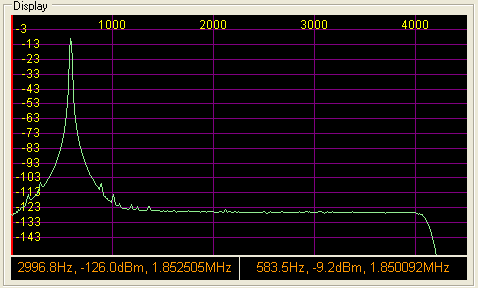
This is the
limit of my measurement capability. The signal is -0.2dBm
below overloading the Delta 44 ADC at -9.2dBm (S9 +64dB). From
500Hz on out the noise is -116 dBc/10Hz. Notice that the PTS 40
source
power is 11 dB greater here to raise its noise to
-126dBm/10Hz. The BDR here is 101 dB in a 500 Hz bandwidth.
Comparing the two measurements we find a 1db increase in BDR for a
1 dB decrease in interferer phase noise. The SDR1000
still hasn't shown
us its LO phase noise!
Summary:
Although I have yet to measure the limits of the SDR1000 the results support my
on-air
operating experience.
An S9 +50dB signal one kilohertz away has no effect on the receiver's
sensitivity. A signal S9
+64dB at the same 1 KHz offset appears to limit the sensitivity to the
S3 level.
On 160M my atmospheric noise on a quiet night is S3 using a beverage antenna.
I've
yet to receive a
signal stronger than S9 +45dB.
At this point it is purely academic to determine the actual BDR of the receiver.
Real world
transmitters
have considerable sideband noise and they will be the limiting factor.
The next step is to use a crystal oscillator to generate the interfering signal
and measure the
true BDR.
Copyright 2006
John Eckert
k2ox